
Flat Tire? Here’s How to Know If It Can Be Repaired Or Needs to Be Replaced
There are few things that derail your day quite like a flat tire. One minute you’re heading to work or picking up the kids, and the next you’re on the side of the road wondering what to do next. It happens to just about every driver eventually, and one of the first questions we hear at Donovan’s is: “Can this tire be fixed, or do I need a new one?”
It’s a fair question, and the honest answer is that it depends on the specific damage. After more than 60 years serving Cincinnati drivers at Donovan’s Auto & Tire Center, we’ve seen every kind of tire situation imaginable. We’re going to walk you through exactly what determines whether a tire can be repaired, when replacement is the smarter call, and what the right repair process actually looks like.
When a Tire CAN Usually Be Repaired
Not every flat means you’re shopping for new tires. In many cases, a straightforward tire repair near me is all you need, and it’s significantly less expensive than a full replacement.
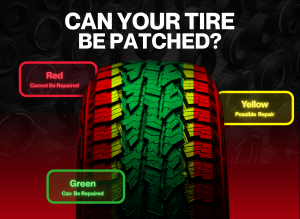
A tire can typically be patched when:
- The puncture is in the center tread area. This is the part of the tire reinforced by steel belts underneath, and it’s the only area where a safe, lasting repair is possible.
- The hole is small, generally less than 1/4 inch in diameter.
- The tire is structurally sound. No internal damage, no compromised belts or cords.
- You caught it early. Driving only a short distance on a flat minimizes internal damage.
The reason location matters so much comes down to how a tire is built. The center of the tread is reinforced by steel, which gives a patch something solid to bond to. The outer edges and sidewall simply don’t have that same reinforcement, which is why tire manufacturers set the center tread as the industry standard zone for any safe repair.
When a Tire CANNOT Be Repaired
Here’s where I have to be straight with you, because this is where safety is non-negotiable.
There are situations where no repair is appropriate, and driving on a compromised tire puts you and your family at risk. A tire generally cannot be repaired when:
- The damage is on the sidewall or shoulder. These areas flex constantly while driving and cannot hold a repair safely.
- The puncture is larger than 1/4 inch.
- There are multiple punctures close together, which weakens the overall structure.
- The tire was driven on while flat for an extended distance. This can destroy the internal structure even if the outside looks okay.
- There’s visible cord damage, bulging, or cracking.
One situation we see more often than people expect: a long nail enters near the edge of the tread. If the tire pressure drops before it’s addressed, that nail can shift and cut into the sidewall as the tire flexes. What started as a potentially repairable puncture can become something that rules out any fix at all. That’s another reason getting it looked at quickly matters.
In any of these cases, tire replacement is the right call. Not because we want to sell you a tire, but because a compromised tire can fail without warning at highway speeds. That’s a risk no repair is worth.
The Difference Between a Patch and a Plug (And Why It Matters)
This is something we want every driver to understand, because it directly affects your safety on the road.
You may have seen plugs sold at gas stations or gotten a “quick fix” somewhere for a few dollars. A plug is inserted into the puncture from the outside without removing the tire. It’s fast and inexpensive, but it’s not a proper repair. Plugs can work themselves loose, and at highway speeds, a plug that lets go means an immediate flat and a serious safety situation.
At Donovan’s, we patch tires instead because we care about your safety. That means we take the tire completely off the wheel, inspect it from the inside, buff down the damaged area, apply rubber cement, and seat a proper patch from the interior. It takes more time and more skill, which is why it costs more. But it’s the repair that’s actually done right.
There’s another important reason to insist on a proper patch: plugging a tire typically voids the manufacturer’s warranty. A correctly done patch preserves that warranty. So beyond the safety difference, a patch protects your investment in the tire itself.
We bring this up not to lecture anyone, but because we hear the question about price fairly often. When customers ask why a tire repair costs what it does, the answer is simple: we’re doing it the right way, which means taking the time to do it safely.
Why a Professional Inspection Is the Only Way to Know for Sure
You can’t always tell by looking at a tire whether it’s safe to repair. The real damage is often internal, in the liner and cords, and it’s only visible once the tire is off the wheel and inspected properly.
That’s why bringing your vehicle to a qualified mechanic near me matters. At Donovan’s Auto & Tire Center, our technicians have over 60 years of combined experience evaluating tire damage. We’ll give you an honest assessment of what you’re dealing with and explain your options clearly, including cost. No pressure, no guessing, no upsell for something you don’t need.
Donovan’s Auto4N Repairs and Sells Tires
One thing many drivers in the area don’t know: Donovan’s Auto4N is a full-service auto repair and tire shop Cincinnati drivers can count on, just like our locations in Pleasant Ridge and Blue Ash. We don’t just handle mechanical repairs. We repair tires properly, mount and balance new tires, and help you choose the right replacement when it’s time for one.
Whether you drive a commuter car, a truck, or a family SUV, we’ll match you to the right tire for your vehicle, your driving habits, and your budget. We carry quality brands and stand behind every installation with our two-year, 24,000-mile warranty.
Quick Safety Tips If You Get a Flat
If you’re dealing with a flat tire right now, here’s what to do:
- Pull over safely and away from traffic.
- Turn on your hazard lights.
- Do not drive on a flat tire if you can avoid it. Even a short distance can cause irreparable damage.
- Use your spare if you have one, or call for roadside assistance.
Get the tire inspected by a professional before making any repair or replacement decision.
FAQ: Flat Tire Repair at Donovan’s
Can a tire with a nail be repaired? In most cases, yes, as long as the nail is in the center tread area and the puncture is smaller than 1/4 inch. A professional inspection will confirm whether a repair is safe. If the nail is near the edge or has caused sidewall damage, replacement may be necessary.
What’s the difference between a patch and a plug? A plug is inserted into a puncture from the outside without removing the tire. It’s a temporary fix at best and a safety risk at worst, particularly at highway speeds. A proper patch requires removing the tire from the wheel, inspecting it internally, and bonding a patch from the inside using rubber cement. Patching preserves the manufacturer’s warranty. Plugging typically voids it. We only patch tires at Donovan’s.
Is it safe to drive on a patched tire? When a tire is properly patched by a qualified technician, yes. A repair that’s done correctly is considered safe and durable for the life of the tire, and the manufacturer’s warranty remains intact.
How long does tire repair take? Most standard tire repairs take 30 to 45 minutes, depending on how busy the shop is. If you’ve already switched to your spare, it’s generally best to set an appointment so you can be in and out as quickly as possible. Because we remove the tire and patch it properly, it takes a little more time than a quick roadside plug, and it’s worth it.
How much does tire repair usually cost? A proper patch typically costs around $50. You may find cheaper options elsewhere, but those are usually plugs, not patches. A plug that fails at 80 miles per hour is not a savings worth chasing. We believe in doing it right the first time.
Do all Donovan’s locations sell new tires? Yes. All Donovan’s Auto & Tire Centers, including our Auto4N location repair and install tires. We’re here whether you need a proper patch or a full set of new tires.
Flat Tires Happen. We’re Here When They Do.
A flat tire is stressful, but it doesn’t have to turn into a major ordeal. Many times, the fix is simpler and more affordable than drivers expect. The key is getting a professional evaluation and making sure any repair is done the right way.
At Donovan’, our automotive team believes in honest, upfront communication, telling you exactly what the tire needs and exactly what it will cost. No surprises. If your tire can be saved, we’ll patch it properly. If it can’t, we’ll help you find the right replacement without the runaround.
Stop in and let us take a look. We’re your neighbors, and we’ve been taking care of Cincinnati drivers since 1958.